











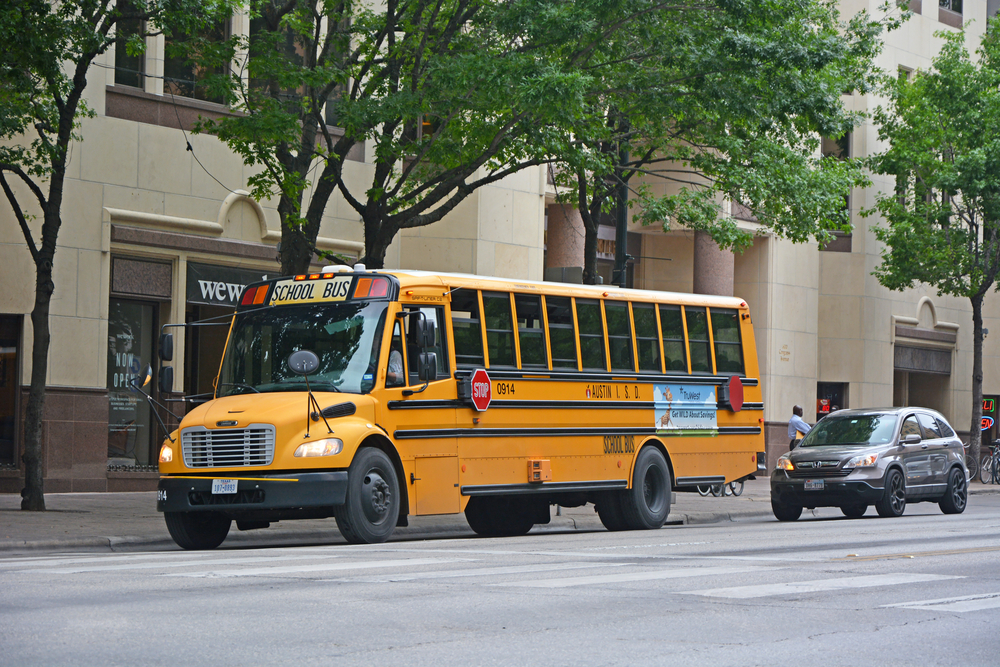
Enrollment in the Austin Independent School District has been on a six-year slide with no end in sight. Consequently, the number of teachers has been steadily decreasing.
During the same period, however, the number of administrators, the highest paid group of professionals in the district, has held fast, while their average base salaries have increased by 32 percent since the 2011-12 school year.
In the 2015-16 school year, 12 AISD administrators were making an average base salary of $100,000 a year or more, an investigation of Texas Education Agency data by The Texas Monitor shows. In this just completed school year, that number jumped to 145. Steadily climbing over the past decade, 116 school principals alone now have average base salaries of more than $100,000 a year, according the the TEA data.
Austin ISD is no outlier. The state’s biggest school districts experiencing declining enrollments (Please see pg. 8 of this AISD report on student population) have little problem shedding teachers, but hold onto their administrative staffs — rewarding them with salary increases that far outstrip increases awarded to teachers in the classroom.
In Austin, where enrollment is off by almost five percent over the past five years, the salary of the district’s superintendent has jumped by almost 10 percent. In Dallas, with enrollment off by about two percent, the superintendent salary is up by nine percent.
In the growing districts, the discrepancy is even more stark. In Fort Bend ISD, where enrollment has grown by 6 percent, superintendent base pay has shot up by almost 23 percent, according to the TEA data.
The biggest jump among large districts is in fast-growing Katy ISD, where the superintendent made $386,850 in base pay alone this past school year, a 13.1 percent increase in just one year and 29.6 percent more than the $298,494 the superintendent earned five years ago.
Katy’s superintendent, however, is no longer earning that pay, having resigned last month, effective Jan. 1, 2019, after having been accused by a former classmate of having bullied him when they were children.
“I can not justify putting my wife and family through it any more,” Dr. Lance Hindt said in his announcement.
Although the investigation into the allegation isn’t complete and the district has expressed its intention to sue Hindt’s accuser, the Katy School Board unanimously agreed to give Hindt a $750,000 severance package.
Taxpayers in North Texas, concerned about the inflation of administrative pay, have also discovered unexplained perquisites. This past week, Grand Prairie ISD officials shared with their taxpayers a report that revealed they had paid $160,000 to renovate the home of Supt. Susan Hull.
Hull, who drew a salary of $390,795 this school year, lives in a home that school district taxpayers brought in 2016 for nearly $700,000. The district rents the home to Hull for $1,000 a month, part of a $75,000 annual package of benefits, according to an investigation by KVTV-TV in Dallas/Fort Worth.
District officials and school board members were unaware of the renovation because contractors broke up invoices to make sure none was more than $50,000 — the threshold for review and approval by the school board, according to KVTV.
“A tipping point is coming in a long-running battle over administration compensation,” said James Quintero, director of the Center for Local Governance for the Texas Public Policy Foundation. “Superintendent salaries are out of control and, unfortunately, it comes at the expense of funding children in the classroom.”
Using the same TEA data sets, Quintero found nearly 40 superintendents in Texas were making base salaries of more than $300,000 a year. In this last school year, 350 superintendents, more than a quarter of all the top administrators in the state, made more than $153,000 a year, the annual salary of Gov. Greg Abbott, Quintero said.
“It isn’t just salaries, there is the larger issue of excessive, rich fringe benefits that are out of control,” he said.
And once installed, administrator positions rarely go away. While teacher totals have decreased every year for the past four in Austin, administrator numbers have remained largely the same, but for a slight drop this past year.
At the same time, average salaries for administrators such as principals, athletic directors and human resources directors have climbed steadily. In the last year alone, the average pay for an administrator in Austin ISD ballooned by 12.8 percent to $92,010, at a cost to taxpayers of $2.4 million, according to TEA figures.
The Texas Monitor contacted Fernando Medina, chief Human Capital Officer for AISD and Geronimo Rodriguez Jr., president of the AISD Board of Trustees, to answer questions about the data uncovered in this investigation. Neither responded before this story was published.
The problem is longstanding. Coming out of the 2011 legislative session, when teacher union leaders and advocates had predicted billions of dollars in funding deficits and more than 10,000 teacher layoffs across the state, school districts responded with some layoffs, but for the most part by declining to fill their thousands of teacher vacancies.
In spite of the panic, when all of the belt tightening was done, administrators mostly survived. Houston ISD dropped 835 teaching positions and 21 administrators, an attrition rate of more than two to one. Cypress-Fairbanks ISD shed 300 teaching positions, all by attrition, and lost just two administrators. Fort Bend ISD’s attrition rate favored administrators by almost five to one.
A year later, a five-year study by the Austin American-Statesman found that while the operating budget for AISD had decreased by nearly $160 million to $724.2 million in 2012-13, the number of administrators making at least $100,000 a year went from 43 to 70.
“I’m not surprised by the numbers,” Roger Falk, an analyst for the Travis County Taxpayers Union, said. “There is a lot of disgust with the spending in the school district And the cost of administration, a non-classroom expense, is a pretty big target.”
AISD officials at the beginning of March solicited public input into how to contend with a projected $30 million deficit for the coming school year. Quintero, in an op-ed in the Austin American-Statesman at month’s end, suggested the district consider taking on what he called “administrative bloat.”
“Past research suggests that if Texas had limited the growth of its non-teaching staff to the same level of growth as its student population over this period, then $2.2 billion could have been saved annually,” Quintero wrote. “Such savings could have gone back into the classroom or given back to taxpayers — either of which would have been a marked improvement over the status quo.”
“Superintendent pay,” Quintero told The Texas Monitor, “is taking money that would otherwise be spent in the classroom. It’s a clear misallocation of resources.”
Mark Lisheron can be reached at [email protected].








“A tipping point is coming in a long-running battle over administration compensation” this cannot be found anywhere on the internet except on the face of this page. your link to it is broken. yes, it’s a bit old, but is it real or did you make it up?
Declining enrollment, firing of teachers, closing schools and selling school buildings to high end Downtown developers in SAISD for multi- millions yet our taxes keep increasing. Local government excuse is that efforts in State funding need to be fixed. This is a local issue, fewer students, staff and facilities should be reviewed instead of increasing our Taxes and making excuses for low performing schools.
Sounds like a good time to have a large layoff of admin staff, starting at the top.
Each and every year the state legislature the Texas education agency and the federal dept of education pile on new and time consuming reports to complete. The reports take hours to complete and require personnel to complete them. Dont blame districts they dont want the additional work and would prefer to have more teachers counselors and social workers in schools.
Your tax dollars at work!
And yet they still vote for the idiots
And that’s why there is a mass exodus of people moving outside of Austin
Good!
Rusty Keith so you think it’s good that Austin is raising taxes and pushing people out?
Think you just meant Austin… not to tag me.
It isn’t just schools who have become Top Heavy . It’s every job in America.
To much at the Top and Nothing where the real work is . Eventually production will stop and we will become like Africa , or another third world country , where no one work’s, and everyone straves
Commies at the top always take from everyone else
Knew this was coming hahahahah
They will tell you it’s all about the children when it’s actually ALL about the money
That’s liberal Austin for you. Enough said…
I’m I’m conservative killeen is the same way here.
Admin cost needs to be capped at a certain percentage for each school district.
That’s where the money is going…not to teaching students…
This information is most disturbing when School Superintendent Jobs are not TEACHING OUR STUDENTS! How did these salaries get soooo out of control WHEN THERE IS NEVER ENOUGH MONEY TO GIVE OUR TEACHERS A RAISE! This is disgusting and a major miscarriage of Justice!
Jesus Cervera are you being repetitive? Public education hasn’t been properly funded for years and years. Where have you been?
Our school system is antiquated. Time for some disruption with technology. Of course this will be fought by the entrenched Bureaucracy.
Maybe, you don’t know. The kids already spend almost all day on I-Pads Teachers not needed
Hmmm wonder why.
Why, teachers scatter from each other instead of working together to promote better in salary and elevate education to a higher standard plus
REMEMBER NOVEMBER
…. 2018 … VOTE
35 SENATORS
9 GOVERNORS
THE WHOLE HOUSE
UP FOR RE-ELECTION
Purple for Parents
Vote out School Board until the problem is fixed. If your team is bad, get a new coaching staff.
Start at the top and cut them loose. Lousy administration too busy changing the names of schools to the tune of $400,000 and enacting ridiculous policies.the teachers unions are strong and you can’t even fire these people.
You must be reading commentary by people from another state or who have no idea what is going on in Texas schools.
Teachers unions are illegal in Texas.
There are no teachers’ unions in Texas.
Teachers are prohibited by state law to collectively bargain.
Is that clear? There are no teachers’ unions.
There are professional associations for teachers, just like there are for every other profession
: lawyers, realtors, CPAs, . . . Journalists. Nothing anyone should take exception to, unless you don’t consider teaching a profession.
There is no “tenure” for any district I’ve heard of in Texas for teachers. In our district, they used to receive three year contracts. Now they have one year contracts.
So just imagine that, every year you have to wonder if your contract is going to be renewed.
They do not pay into or receive social security, they instead pay into the Texas Teachers Retirement system. Now you and I may change jobs, and even professions, and we will still have our social security benefits. Teachers have to pay into the TTRS for a certain number of years before they are funded.
So their short term and long term financial security is in a much more precarious situation than most of the rest of us, and remember, they don’t have unions. They have short term contracts and so if they get on the wrong side of the administration, they won’t be renewed. If they push back or protest too much, they won’t be renewed . . . And again, they don’t have unions looking out for their interests.
I have had MANY teachers tell me they couldn’t speak out about one thing or another because it would be “career suicide.”. If they are known as a problem to administration, they will be blackballed in other districts. That has an impact not only on their present income, but their retirement as well, because remember, they don’t pay into social security and if they aren’t teaching and paying into TTRS, then aren’t going to get that retirement.
So without anyone to look after their interests, we have situations like the ones we see in our district where a teacher when relaying her experience of being assaulted by a student while she was pregnant apologized and said she ” wasn’t complaining” but she was afraid it would cause another miscarriage. Or a situation with another your teacher who was verbally abused daily and slapped directly in the face by a 6 year old, and the administration response was to pull the classroom support (originally provided to protect other students in the class from his aggression). Or an associate principal who was demoted after discovering a situation of nepotism and fraud. Or told by the administration that if they speak out against our recent boondoggle of a bond they will be fired.
As for the comment that administration costs need to be limited, it is by state legislature to 40 percent of the total budget. It is up to the individual districts how they allocate the funds up to that limit.
If you don’t like how your local district is allocating the funds, my question to you is . . . What are you doing about it?
Are you attending or watching the board meetings?
Are you voting in the school board elections?
Are you voting in the bond elections. I see a lot of comments complaining about school taxes with a reference to “they” keep raising them. Who is this “they?”. YOU are the one voting on both the bonds and measures that determine the tax rate and the school board that oversees the allocation.
Quit playing the victim, take responsibility and get your butt to the poll.